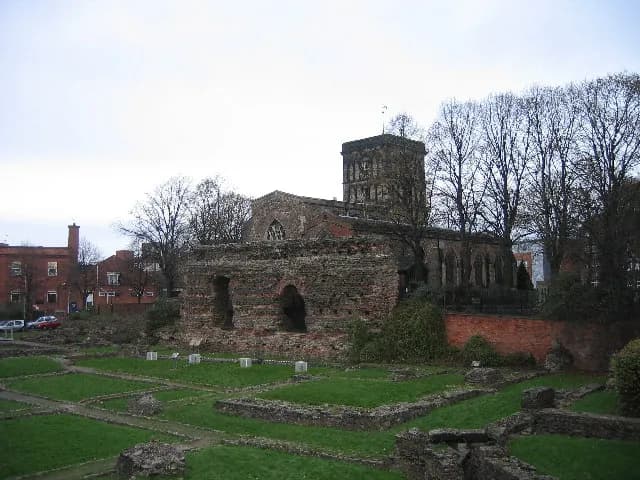
Standing eight metres tall on St Nicholas' Circle, the Jewry Wall has witnessed Leicester's entire written history. Built around 125 to 130 AD, this 23-metre stretch of Roman masonry remains one of Britain's largest surviving pieces of civil Roman architecture.
From Bath House to Enduring Monument
The wall formed the west side of the palaestra, or exercise yard, attached to Leicester's Roman public baths. Constructed from alternating bands of Roman brick and coursed masonry of local granite, limestone, and sandstone, it features two large arched openings roughly three metres wide and four metres high. Archaeologists now date the baths complex to approximately 145 AD, slightly later than the wall itself.
The structure stands as a rare survivor. While Roman military installations such as forts and Hadrian's Wall left substantial remains, civil architecture from the period rarely endured. The Jewry Wall is comparable in significance to the "Old Work" at Wroxeter, making it exceptional evidence of urban Roman Britain.
Archaeology That Shaped a Discipline
Between 1936 and 1939, a young archaeologist named Kathleen Kenyon excavated the site. Her four seasons of work at Leicester launched a career that would later make her world-famous for stratigraphic excavation methods at Jericho. Kenyon initially believed the Jewry Wall site was Leicester's Roman forum; her findings contributed to developing the Wheeler-Kenyon method still taught to archaeology students today.
Later excavations from 1961 to 1972, led by Max Hebditch and Jean Mellor, identified the actual forum location one block east. Their work confirmed that the Jewry Wall belonged to the baths complex, not the town's administrative centre.
A Name Shrouded in Mystery
First recorded around 1665, the name "Jewry Wall" has puzzled historians for centuries. Three theories compete for acceptance. The oldest suggested a connection to Leicester's medieval Jewish community, though this has been discredited; the community was never large and was expelled from the town in 1231.
A second theory links the name to "jurats", the 24 sworn men who served as medieval Leicester's senior council members. These officials supposedly met as a jury near St Nicholas' Church, which incorporates reused Roman materials in its fabric. This explanation, while popular, lacks strong documentary evidence.
The most likely origin lies in medieval folk belief. Across England and Europe, mysterious ruins of unknown origin were commonly attributed to Jews. The name reflects how post-Roman societies interpreted remnants they no longer understood.
What Lies Beneath
The excavations revealed more than the wall itself. Beneath street level, archaeologists uncovered the foundations of Leicester's Roman baths, complete with furnaces and hypocaust systems. The site yielded thousands of artefacts now housed in the adjacent museum, including the celebrated Cyparissus Mosaic, the Blackfriars Pavement, Norfolk Street Roman wall paintings, and a bronze key handle depicting a man grappling with a lion.
These finds paint a picture of Ratae Corieltauvorum as a sophisticated provincial capital. The baths complex, fed by an aqueduct from earthworks known as Raw Dykes, represented a major public investment in a town that served as the tribal centre for the Corieltauvi people.
A New Chapter
In July 2025, the Jewry Wall Museum reopened following an £16.8 million renovation. The project, which faced delays from the COVID-19 pandemic and contractor insolvency, transformed the visitor experience. New glass walls connect the ancient structure with modern exhibition spaces, while multimedia displays allow visitors to experience Roman Leicester as it appeared in 160 AD.
The museum now houses over 100 Roman artefacts discovered across Leicestershire, displayed alongside interactive exhibits and immersive film presentations. Leicester City Council operates the museum, while English Heritage maintains responsibility for the wall itself.
Visiting the Site
The Jewry Wall stands at St Nicholas' Circle, Leicester LE1 4LB, adjacent to St Nicholas' Church. The site holds Grade I listed status and is protected as a scheduled monument. The museum opens Monday to Friday and Sunday from 10:00 to 16:00, and Saturday and Bank Holidays from 10:00 to 17:00. Visitors are advised to book in advance through the museum's website.
After nearly two millennia, the Jewry Wall continues to serve its original purpose: bringing Leicester's residents together in a shared public space.