Leicester Market has operated continuously for approximately 800 years, making it one of England's oldest trading institutions. Its survival through centuries of urban transformation rests partly on a Royal Charter that has protected its trading monopoly for more than 700 years.
Origins of a Medieval Trading Hub
The market traces its origins to the 1220s or 1240s, when it was established as a chartered trading post. Approximately a century after its founding, the market moved to its current location in Market Place, just south of the Clock Tower, where it has remained for roughly 700 years. This makes the Market Place site itself a medieval survivor, with the street pattern still visible in the layout today.
The location has housed structures serving civic and commercial functions for centuries. Before the current Corn Exchange building, the site was occupied by The Gainsborough, completed in 1509, which served as a prison, law court and shopping destination with dungeons beneath. The New Gainsborough, built in 1748, functioned as a corn exchange with its first floor used for magistrates' court hearings.
Royal Protection and the Six-and-Two-Thirds Mile Rule
The market's Royal Charter, granted over 700 years ago, contains a provision that has shaped Leicester's commercial geography for centuries. The charter prohibits any other market from operating within 6⅔ miles (10.7 km) of Leicester Market, effectively creating a protected trading zone around the city centre. Leicester City Council holds this charter and has historically enforced its provisions, though in recent years it has allowed some exceptions, such as a proposed Sunday market at Walkers Stadium in 2009.
This royal protection ensured that Leicester Market maintained its dominance as the city's primary trading hub throughout the medieval and early modern periods, when competing markets could have fragmented commercial activity.
The Victorian Corn Exchange
The Grade II* listed Corn Exchange building, which dominates Market Place today, was constructed in two phases. Architect William Flint designed the original single-storey trading hall in 1851, which was extended by Frederick Webster Ordish in 1855 to create the building that stands now. The structure features a clock by E. T. Loseby of Leicester and a weather vane shaped as a wyvern, the symbol of the city.
The building served as Leicester's centre for grain trading during the Victorian era, reflecting the agricultural prosperity of the surrounding region. Architectural historian Nikolaus Pevsner particularly noted its spectacular staircase. Since July 2000, the building has operated as a Wetherspoons pub (Lloyds No. 1), representing another chapter in the site's continuous adaptation.
A statue of John Manners, 5th Duke of Rutland, sculpted by Edward Davis and unveiled on 28 April 1852, stands near the Corn Exchange, commemorating a figure who played a significant role in Leicester's development.
The 1970s Indoor Market and Its Demolition
In 1973, a multi-level indoor market building was constructed to complement the outdoor trading area. This facility contained a fish market, delicatessen, and stalls selling clothes, haberdashery, footwear, jewellery, gemstones and confectionery. The building served traders and shoppers for four decades before its demolition in December 2014 and June 2015.
The demolition marked a significant transformation in the market's physical form. Traders were relocated to a new Food Hall, built adjacent to the Corn Exchange and opened in April 2014, or to outdoor market stalls. The former indoor market site was converted into New Market Square, creating additional open-air trading and public gathering space.
The Market Today
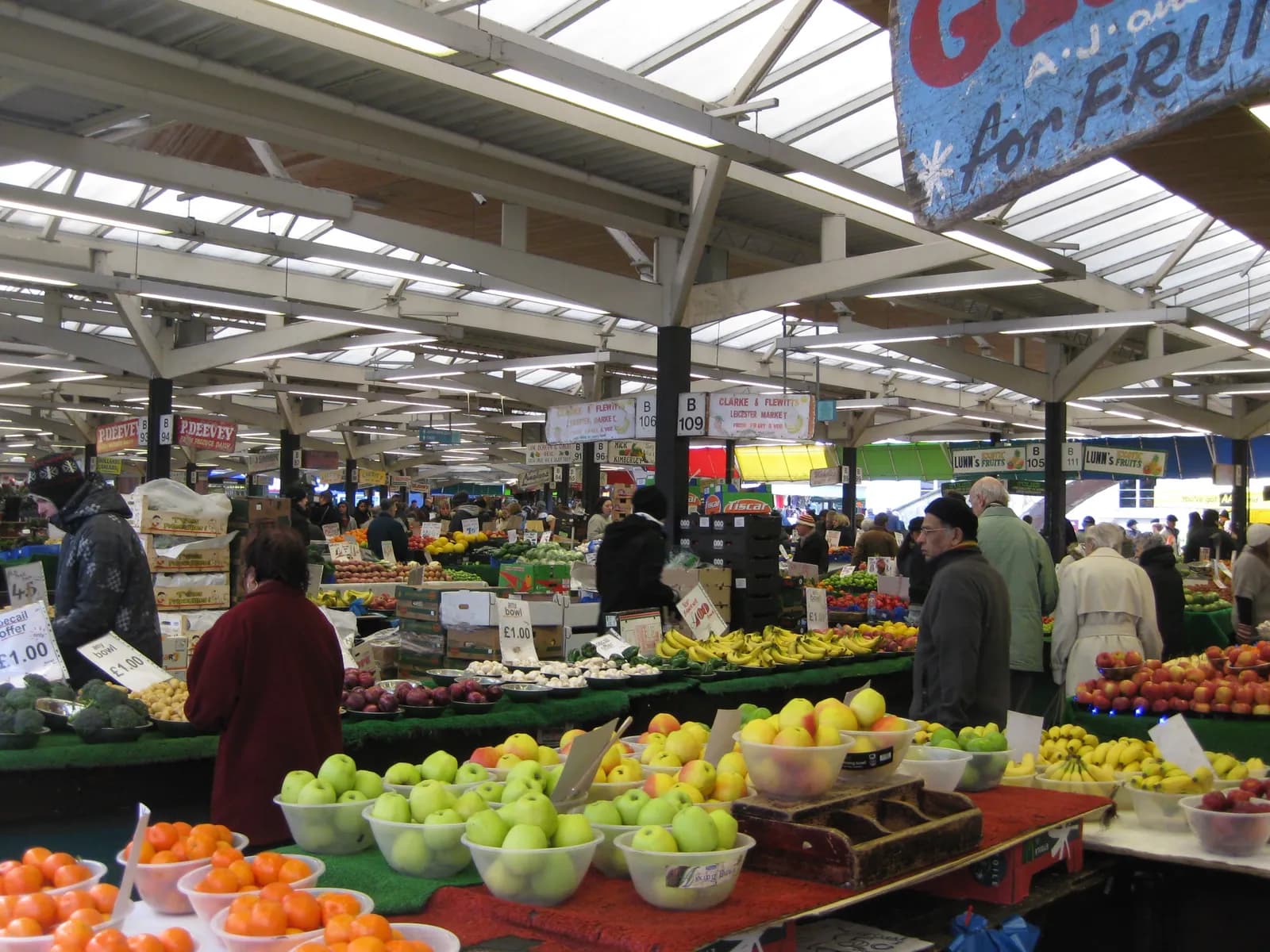
Leicester Market operates Monday to Saturday from 9 am to 6 pm. The outdoor market features over 10-15 stalls selling fruit, vegetables, flowers, clothes, second-hand books, bric-a-brac and jewellery. Permanent units within the market area offer clothes, cosmetics, fabrics, greetings cards, a cafe and pet products.
The market has been described as the largest outdoor covered market in Europe, though this claim has not been independently verified. On the last Wednesday of every month, a Farmers' Market operates on Gallowtree Gate, specialising in locally produced organic meat, fruit and vegetables.
Survival Through Adaptation
The market's longevity stems from its capacity to evolve. From medieval chartered trading to Victorian corn exchange, from magistrates' court to 1970s indoor market, from traditional stalls to modern Food Hall, the site has continuously reinvented itself while maintaining its core function as Leicester's primary marketplace.
The Royal Charter provided legal protection, but the market's survival ultimately depended on adapting to changing economic conditions, shopping habits and urban development pressures. The demolition of the 1973 indoor market represented a loss of purpose-built infrastructure, yet the market adapted by consolidating outdoor operations and creating New Market Square.
Local Significance
For Leicester residents, the market remains a fixture of city centre life. The Market Place has served as a civic hub for centuries, hosting events from the 1911 Coronation celebrations for George V to a 1914 speech by Labour leader Ramsay MacDonald. Today it continues to function as a social and commercial gathering point, connecting the city's medieval past with its contemporary urban fabric.
The combination of historic architecture, protected trading rights and continuous operation makes Leicester Market a rare survivor among England's ancient marketplaces. While many medieval chartered markets have disappeared or been reduced to occasional events, Leicester's market maintains daily trading operations in substantially the same location where merchants set up their stalls eight centuries ago.