In the summer of 1841, a 32-year-old printer and temperance campaigner walked 15 miles from Market Harborough to Leicester for a meeting. That journey planted the seed of an idea that would transform travel forever.
Thomas Cook, who had settled in Leicester earlier that year, organised what historians recognise as the first publicly advertised excursion train in England. On 5 July 1841, 485 members of the Leicester Temperance Society boarded a train at Leicester Campbell Street Railway Station and travelled the 12 miles to Loughborough for a temperance rally. Each passenger paid one shilling, which covered the cost of hiring the train from the Midland Counties Railway. The modern package holiday had been born.
From Printer to Travel Pioneer
Cook was born on 22 November 1808 in Melbourne, Derbyshire, the son of a labourer who died when Cook was four. After leaving school at ten to work as a gardener's boy, he served an apprenticeship as a cabinet-maker before becoming an itinerant Baptist preacher in 1828, earning £36 a year distributing tracts and establishing Sunday schools.
He married Marianne Mason in March 1833 and settled in Market Harborough, where he worked as a wood turner. When the family moved to Leicester in 1841, Cook established himself as a bookseller and printer. He and his wife, along with his mother, also ran two temperance hotels in the city. The temperance movement remained central to Cook's life; he had signed the pledge in 1836 and viewed organised excursions as a means of keeping working people away from public houses.
Building a Travel Empire
The Loughborough excursion proved the concept, and Cook quickly expanded his operations. In 1845, he organised his first profit-making tour, taking a party to Liverpool, Caernarfon, and Mount Snowdon. The following year, he added Scotland to his itinerary.
By 1851, Cook had arranged travel for 165,000 people to the Great Exhibition in London. That same year, he launched Cook's Excursionist, a monthly magazine featuring travel advice and customer testimonials. His first continental tour came in 1855, a "grand circular tour" through Belgium, Germany, and France for the Paris Exhibition.
The company introduced innovations that remain travel industry staples today. Hotel coupons, launched in 1868, allowed travellers to pre-pay for accommodation. Circular notes, introduced in 1874, were an early form of traveller's cheque. In 1874, Cook advertised his first round-the-world tour, priced at 200 guineas.
In 1872, Cook formed a partnership with his son, John Mason Cook, and the business became Thomas Cook & Son. The company acquired premises on Fleet Street in London in 1865, though the elder Cook maintained strong ties to Leicester throughout his life.
Leicester Remembers
After retiring in 1878, Cook returned to Leicester and built a house called Thorncroft on London Road, where he lived until his death. He was buried in Welford Cemetery.
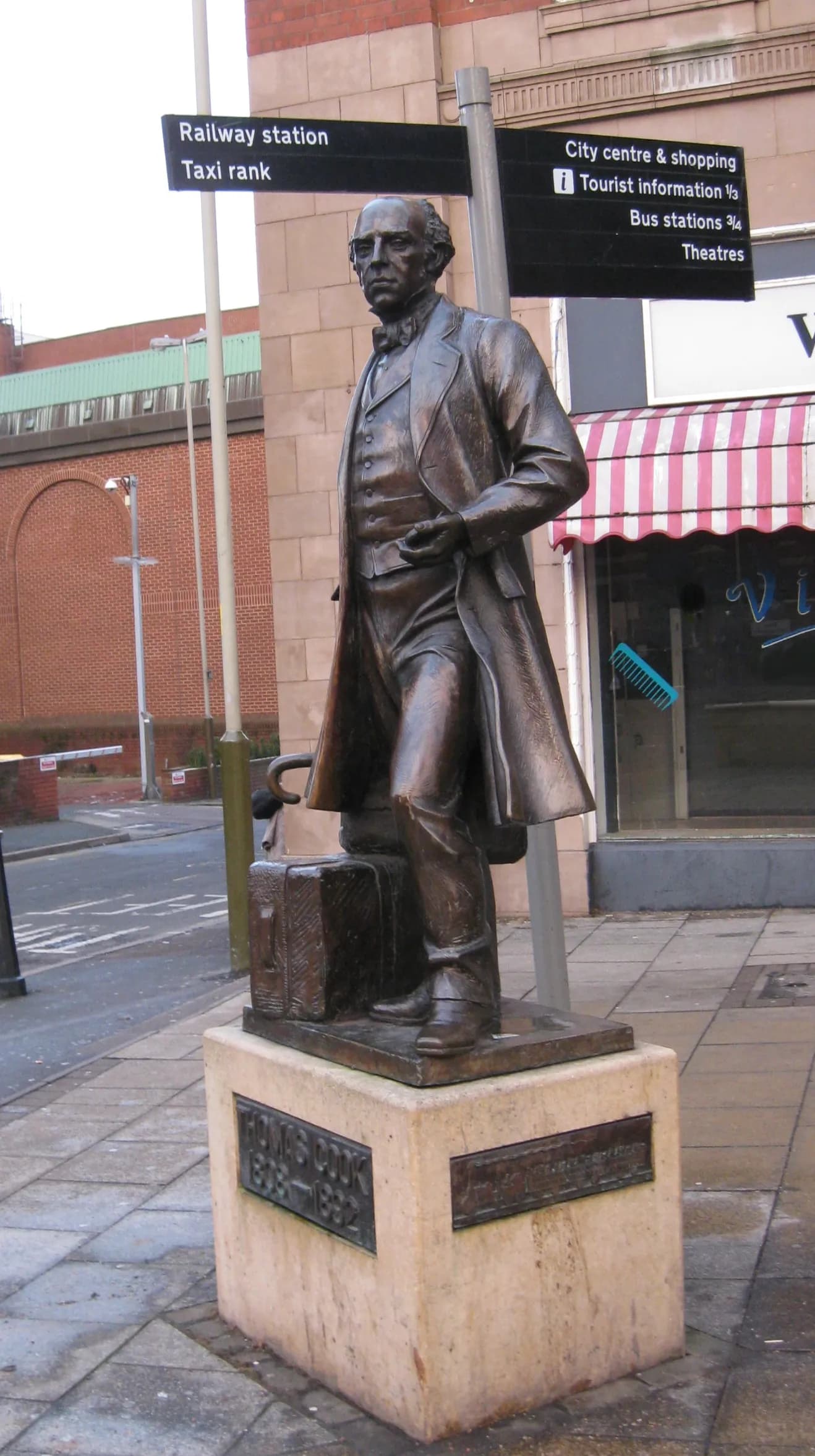
Today, Leicester honours its most famous travel pioneer in several ways. A bronze statue by James Butler stands outside Leicester Railway Station, unveiled on 14 January 1994 to mark the 150th anniversary of that first excursion. A blue plaque adorns Thorncroft, his former home on London Road. The city can credibly claim to be the birthplace of modern tourism; an industry that now moves billions of people annually across the globe began with a single train journey from Leicester to Loughborough.